
- Home
- Arts & Culture
- ‘The Voice of Hind Rajab’ screening in Tokyo urges audiences to become witnesses
‘The Voice of Hind Rajab’ screening in Tokyo urges audiences to become witnesses
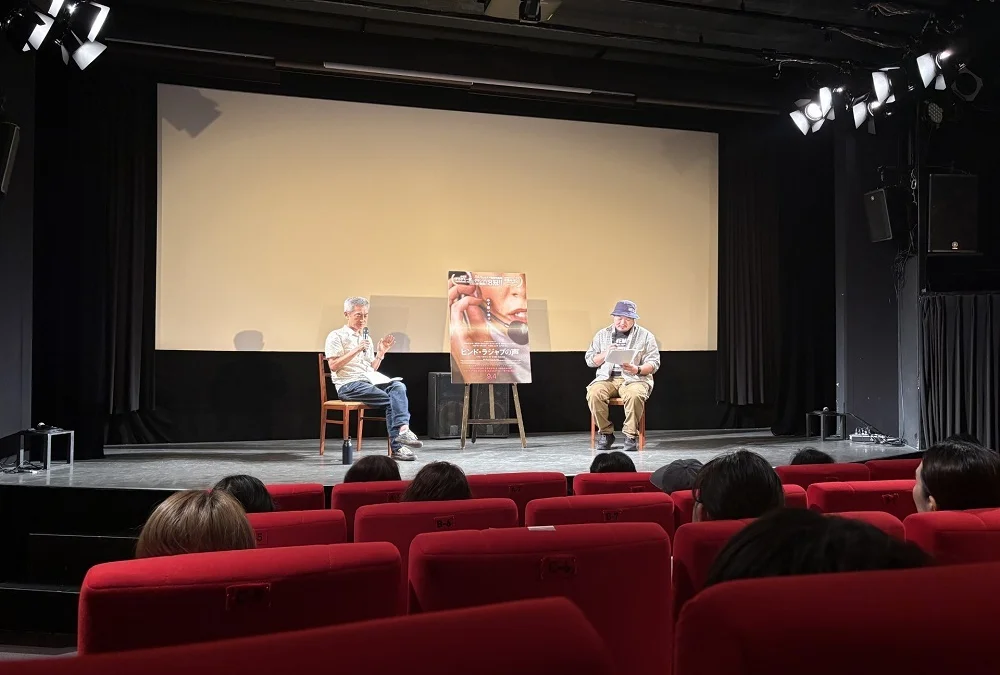


TOKYO: A special screening of the Gaza-related film “The Voice of Hind Rajab” was held in Tokyo on Tuesday, followed by a talk examining the film’s blend of documentary and fiction and its call for audiences to become witnesses to the reality of the tragic situation in Gaza.
The film, directed by Tunisian filmmaker Kaouther Ben Hania, reconstructs the final hours of six-year-old Palestinian girl Hind Rajab, who was trapped in a car in Gaza and called the Palestine Red Crescent Society for help.
The production uses Hind’s actual emergency-call audio together with performances by actors portraying humanitarian workers attempting to rescue her.
Ben Hania is known for films that move between documentary and fiction. Her previous works include “Four Daughters,” which was nominated for the Academy Award for Best Documentary Feature, and “The Man Who Sold His Skin,” which received an Academy Award nomination for Best International Feature Film.
Following the screening, writer ISO and documentary filmmaker Arata Oshima discussed the artistic and ethical choices behind the film.
Oshima said he usually declines requests to comment on fictional films, but accepted the invitation to discuss this work because of what he described as its extraordinary power.
He called the film “the best work a filmmaker can do,” saying that if he had obtained the same audio material himself, he would probably have made a more conventional documentary based around interviews.
Instead, Ben Hania used actors and cinematic reconstruction to create an emotional impact that, Oshima said, may have been difficult to achieve through a conventional documentary alone.
ISO explained that the director deliberately blurred the boundary between fiction and documentary. According to the discussion, actors were not allowed to hear Hind’s real recorded voice until filming, allowing their reactions to emerge more spontaneously.
Oshima also raised the ethical question of using the voice of a six-year-old child who could not give consent herself. He noted that permission had been obtained from Hind’s mother and suggested that the need to communicate what happened in Gaza may have outweighed those concerns.
The speakers also discussed the concerns of audiences consuming the film simply as a work of entertainment.
ISO said the director repeatedly reminded viewers that the story is rooted in reality, including through the use of sound-wave imagery and other elements linking the reconstructed scenes to the actual incident.
A central theme of the discussion was the director’s wish that audiences should not simply cry and return to their daily lives.
The film, the speakers said, is intended to turn viewers into “witnesses” and to transform feelings of anger and helplessness into motivation to act.
The talk also referred to reports that the Israeli occupation military later opened a criminal investigation into the incident. However, the speakers stressed that such developments should not be taken as evidence that the broader situation in Gaza had fundamentally changed.
At the end of the discussion, Oshima encouraged viewers to begin with something simple if they felt unsure what action they could take.
He urged them to tell friends and family about the film, share information on social media and help keep public attention focused on Gaza.